


Button Books £12.99
ISBN: 978-1-78708-189-9
We have been a great fans of the Factology series and guess it had to happen – we have had a Factology book on Dinosaurs and now for another name that strikes fear into our hearts at the very word and of course we will only have the chance to have an encounter with a live shark unless Jurassic park is made for real.
This book follows the tried and tested formula of the series in that it has many different topics all of which are filled with fun facts and tons of illustrations and photographs. There is the traditional big quiz at the back – here is a sample question – what are 67% of sharks inbfected with? , and a small glossary (galeophobia, algae etc)
You don’t have to go scuba diving to come face to face with a shark and several species can be seen in aquariums. A whole section is devoted the the aquarium at Brighton which is 150 years old and seen plenty of changes in its history.
Oh – dont expect to see a Great White in captivity. Previous attempts in the U.S.A have met with expensive failures – some creatures have too wide a range – like a whale, to survive in even the biggest of tanks or closed off bays.
You can even see a shark on dry land in Oxford. Just look to the left when about to go down the hill from Headington and you will see a bizarre sight.
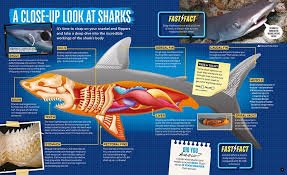
Think you know a lot about sharks – well think again. There are thousands of scales of the same enamel as teeth on them which can be felt if you ever get close to brushing one towards the nose. These are called denticles. then there are the two types of muscles, the sharks that can move their stomachs to their mouths for a wash, and as for teeth there are some great facts about them be it re-growing, comparing sizes or just how sharp they are!
There is a small section on the prehistoric sharks that are now extinct. Give thanks that you never lived in the same era as a Megalodon which produced teeth 18cm long and would weigh between 50 and 75 tons. There are plenty of others who are no longer with us with possibly the strangest being the buzzsaw.
There are anatomical drawings and mentions of quite a few of the over 500 species of shark. Yes the great white gets it’s fair share of coverage but we can also read about the unlethal (to us) basking shark and the incredibly small cookiecutter.
This is the 11th in the series and it shows that the series is going from strength to strength. The KS2 and KS3 school curriculum is consulted when devising each volume, to ensure that the books cover important educational topics, making them a perfect teaching aid for learning history and STEM subjects.